Thursday, February 25, 2021

Landscape Quilting in progress


My second landscape quilting project.  Most people, when they think of landscape quilting, think of strips of fabric sewn onto a background piece to resemble great swaths of countryside.  That isn't the landscape quilting that I was introduced to and I prefer something with much greater detail. I think it is rather like one's taste in art; I have never been drawn to modern art or interpretative art, but I love art that is completely realistic.  I love the use of the artist's brush to make details that are so true-to-life, better even than photography because they have been rendered by hand.  

I have tried to reproduce in fabric what one man did with his paintbrush. He called it All in the Family, a scene of birds coming to a feeder and bird house in winter, against a background of a house with wood siding and holly branches. 


The artist is William Mangum and I discovered him through a zigsaw puzzle that I did. 

file:///home/chronos/u-5c38bd7175b50a50d3345622b01465c5e43fcc0e/MyFiles/bird%20feeder/All%20In%20The%20Family%20-%20Limited%20Edition%20-%20William%20Mangum%20Fine%20Art.mhtml


And this is my effort so far. I have cut all the fabric pieces and sewn them onto a background fabric that is a mottled grey. The sewing is free-motion quilting through three layers, the background fabric, a light quilt batting, and another fabric for the backing. The stitching is done with invisible thread on the top and a thread to match the backing in the bobbin.


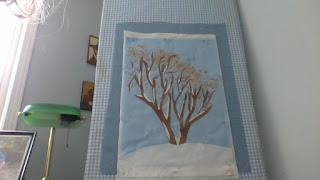
The completed wall-hanging is 13 by 24 inches, about the same size as the original painting.


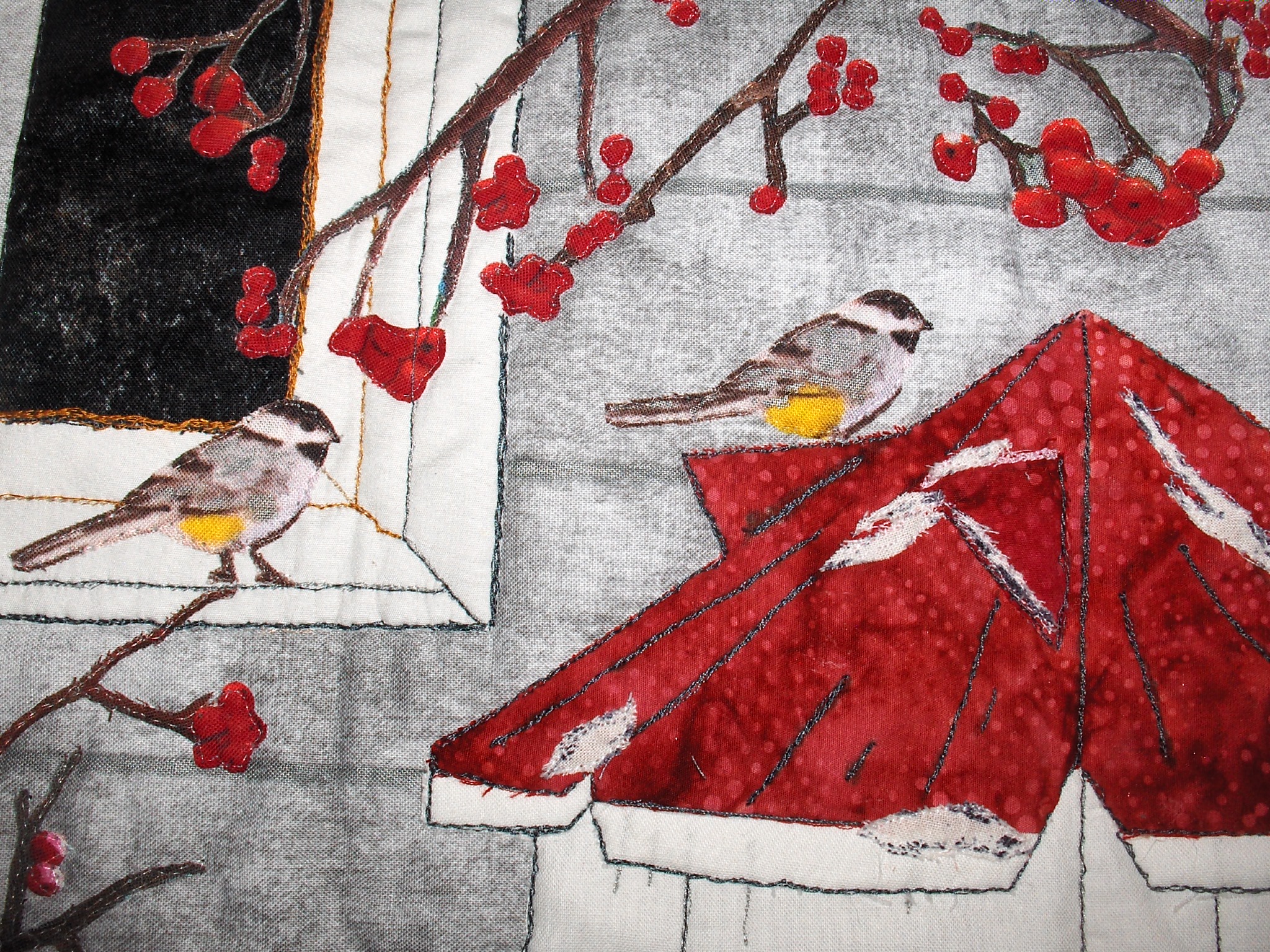
I only had access to chickadees for my birds, so all of them are the same type of birds. I don't have the variety that Mangum had in his painting.  If I find fabric with other birds that are the right size, I can always sew them on top of the birds there now.

A close up of the project, perhaps you can see the free-motion stitches

What is left to do now is to bind the quilt.  I will use the same fabric as the one used for the window top left.  The binding will be a narrow 3/8" binding, I won't do a double binding as I want the image to be the prime focus.  After that, I am going to do shading with oil and wax pastels in order to simulate the shadows that are in the painting.  

Perhaps this will never be finished!  I have been working on it for over a month now, I always see something new that should be done.  But I have thoroughly enjoyed the whole exercise. I don't think I have been so engrossed in anything for a long time; two hours at the sewing machine flies by and I look forward to more of these landscape quilts in the future. 

I will post a picture of the finished wall hanging once the binding is on and the shading is complete.


Saturday, February 20, 2021

Winter Sowing 2021

 I have sowed 47 bottles so far.  Here's hoping for success.  I watched a youtube video from Getting Clean on the Prairies  (https://www.youtube.com/watch?v=hWENZMdym9s).  She lives in a zone 3A in Saskatchewan and her weather seems pretty similar to ours here in central/northern Ontario.

Last year was the first year she tried winter sowing and she met with 75% success.  I will be thrilled if I meet with that much success, even 50% would make me happy.


The patio table with bottles now covered with snow


The picnic table now taking the overflow

My husband says it looks like a dinner set out for a feast and all the guests disappeared and winter came in.  Perhaps some alien from space would find this and wonder what everyone was drinking. 

So I have sowed seeds for pansies, snapdragons, hollyhocks, lupins, lavatera, marigolds, shasta daisies, poppies, alyssum, foxgloves, calendula, gernaiums, petunias, columbine, amaranth dread locks, cosmos, larkspur, rudbeckia, forget-me-nots, nigella, nicotiana, canterbury bells, bachelors buttons, bells of Ireland, blackeyed susans, and sunflower cherry rose.  And one container with leeks.  That is the only vegetable so far, but I will also winter sow a few varieties of lettuce, and tomatoes can be started this way in mid March.  

Fingers crossed.  At least no one can see our back yard unless they have a pair of magnifying glasses. So I don't look as foolish as I feel about this.  


Sunday, January 10, 2021

January update


Mid January in central Ontario, snowy and  cold.  But yesterday and today are sunny, which makes a huge difference to how one feels and what one wants to do. Taking a walk is pleasant (if it isn't windy) and people were out sledding, skating, cross-country skiing, and ski-dooing.  This is what you do here in winter, and the sound of snowmobiles is pretty constant.  Oh and ice-fishing.  Several huts are out on the lake and people can drive out to them, amazing that the lake has frozen this quickly. It was water a week before Christmas and now the ice must be a foot thick.


Here are the snowbanks from early January, already two feet high.


And the front yard, crisscrossed by my boots and by the deer that come here in the early hours of the morning.  What they eat in winter is a mystery to me. They must be starving.


My amaryllis fell over in the night, as the blooms got too heavy for the stalks.  There are six blooms on it now, gorgeous red and two feet tall. I have velcro-ed it to a vase full of marbles to keep them upright.


And so anxious to get going on spring planting, I jumped the gun and started some winter sowing. I know I should wait another month, but I just can't.  So I sowed two containers with red hollyhocks, one container with pansies and another with snap-dragons. The challenge is to find enough containers, I have resorted to taking them from people's blue bins on re-cycling day.  


Tuesday, January 5, 2021

January Gardening


Not too much happens in central Ontario in mid- January, it's too cold to do anything.

But I did grow an amaryllis plant that I bought at Home Hardware sometime in November.

And look how it turned out!  two stalks, one has 3 flowers on it, the other is also producing 3 flowers and there are 2 shorter stalks coming from the bottom. Incredible amount of flowers from a single bulb.  I had grown white amaryllis before and found the smell quite unpleasant. These red blooms have no smell. The stalks are a good 22-24 inches tall. 


And while there isn't much to do, it is time to check on the dahlia tubers stored in the basement. On the advice of a neighbour who grows wonderful dahlias, I brushed these off and dried them for a few days, then stored them in plastic grocery bags loosely tied up.  She told me to check them after Christmas and open the bags so that they don't get too damp. 

I opened them today and found mold on quite a few. So a google search found a site where a woman said she save 700 tubers from mold by dunking them in a solution of bleach and water, drying them off, and then re-storing them in peat moss.  I have no peat moss, so I did dip them into a bleach solution and then air-dried them on a towel. Once dry, I wrapped them individually in newspaper (loosely) and put them back into the cardboard boxes and back into the basement storeroom.  


I figure I have nothing to lose by doing this and I would actually lose them if I did nothing. I will check them again in a month to see what's up.  On some of the larger tubers, I noticed there are already sprouts coming up from the roots. Exciting!  I have 13 dahlias stored this way, and I just ordered another dozen dahlias from The Dahlia Expert.  It's going to be a summer of flowers!


Sunday, December 27, 2020

Landscape quilting progress

Today I tackled the mitered borders on the landscape quilt.  Although far from perfect, I am satisfied with the results and will move forward. Next step is to bind the quilt  (easy as I have done a lot of binding in my sewing years)  and then the fun part, free motion stippling.  That will be the best part of this whole project.


I chose a subtle printed cotton in the same orangey-gold shade of some of the flowers to be the inner narrow border. A 1-inch wide strip was sewn to 4" wide strips of the background fabric.  They were then sewn to the trimmed quilt picture, and I spent several hours trying to get the miters as good as possible. I resorted to hand sewing two of the miters as I just could not get them right on the machine. I doubt that my miters are actually 45 degrees, but who is checking?  


Now I can see that you want a bigger picture to begin with as there isn't that much area for stippling. Not to worry, there are going to be more of these quilts in my sewing future. I already have a second one planned in my mind and am anxious to get fussy cutting for that one. 

Overall, I am fairly pleased with my final result here, I will post once more with the finished quilt, once it is bound and stippled, blocked and hung on the wall. 

My thanks to Nancy Zeiman and Natalie Sewell for their wonderful books on landscape quilting. I often thought of Nancy as I was making this, and I hope to meet her one day in the great beyond.


Sunday, December 20, 2020


I am trying my hand at landscape quilting. Recently diagnosed with rheumatoid arthritis in my hands, I have found most hand activities too painful to do. But I can't live without fabric creations (or gardening for that matter) and I thought perhaps I could cut and assemble pictures with fabric.

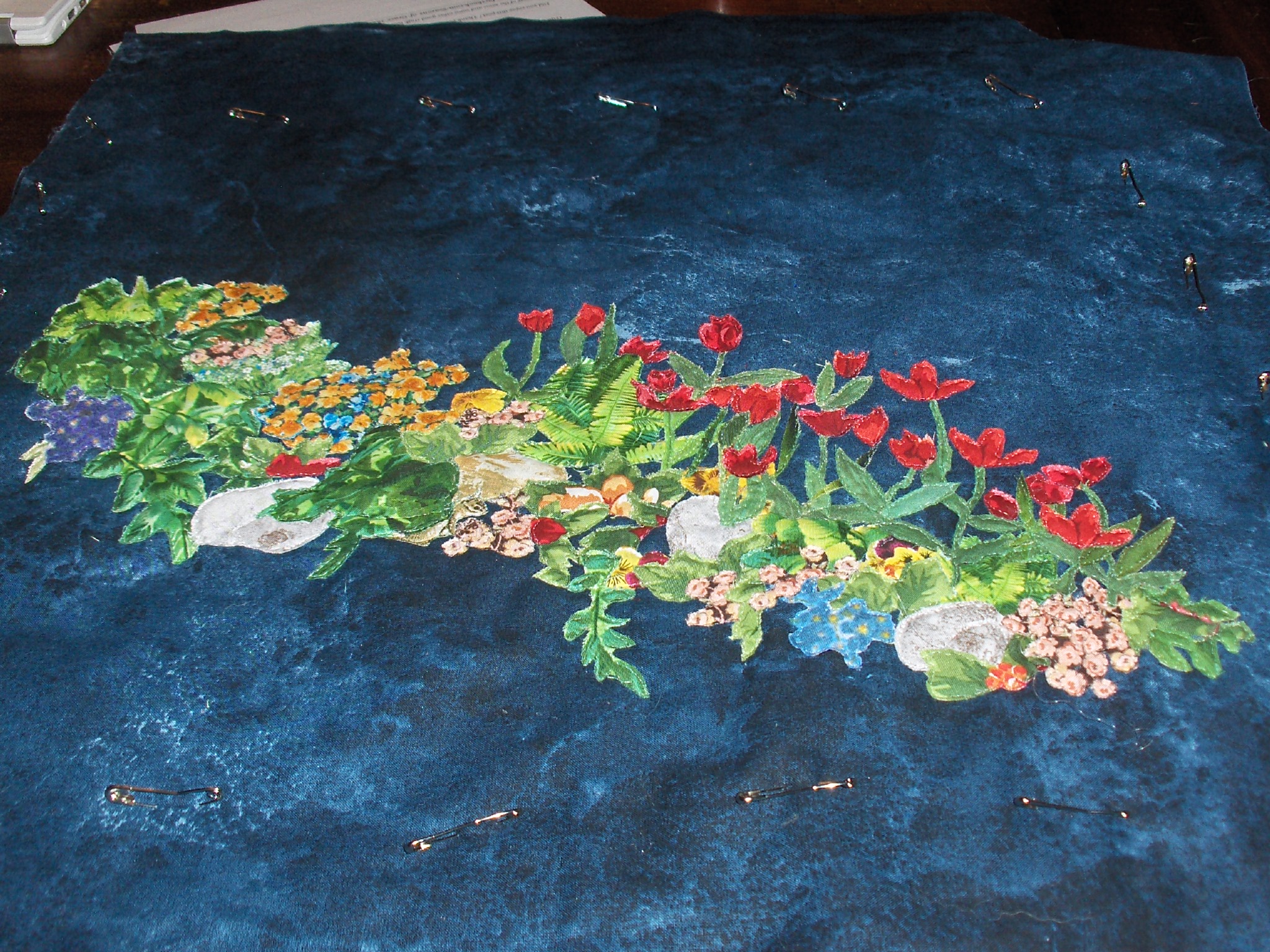
Inspired by the late Nancy Zeiman and her friend Natalie Sewell, I took this project from one that Natalie did of a rock garden. You cut leaves and flowers from  various fabrics and then assemble them in layers on a background fabric.  I chose a batik quilting cotton for the background, a dark blue with splashes of white through it.  Then cut out foliage, first I cut just green shapes from fabric that looked like greenery but then I realised I actually needed leaf shapes.  So those first cuts were discarded and I "fussy cut" leaves from several different fabrics, colouring the ones that weren't quite the right green with permanent markers. Then flower shapes, and a lot of cuts to resemble tulips. I couldn't find tulip fabric so had to improvise. Also the tulip leaves were cut from other leaves and reshaped to resemble tulips. 


This is a photo of the quilt with all the flowers and leaves stitched onto it. Now I have to make a border to resemble a photo mat, I have chosen a quilting cotton in the golden orange shade of some of the flowers. Then a second border of the background fabric is  added, then a final thin binding is put around the edges. 
And the final step is to stipple quilt the entire background. This is done free- motion (feed dogs down) and I love doing this. I made a jacket a number of years ago, all the fabric was stippled before constructing the jacket and I still wear that jacket ten years later. 

A close up of the fabrics assembled and stitched to the background

A close up of some of the tulips

My hands are objecting to  the work, so I can only do about half an hour at a time, but it is so incredibly satisfying.  I already have several ideas for future projects I want to do.  


Saturday, August 8, 2020

August garden update


Not too much new in the garden. I have been diagnosed with tendonitis brought on by gardening work. Which means my arms and shoulders hurt so much that I have no strength to do much work. Also I have carpal tunnel syndrome in both hands, ouch!  which explains why I can't knit at the moment either.  But I did make a trip to Gerber's nursery last week and bought two plants. Gerbers used to be a busy nursery but it looks as if they are downsizing. The owners died and the son lives 4 hours away, I don't think he has the interest to keep the family business going. 


In this bed are some annual lavatera that I grew from seed. They look like malva flowers.
Close up of the meadow sweet.
Daylilies and phlox in the same bed.
Japanese bottle brush planted last year as bare roots.
A couple of balloon flowers that need staking.
The weigela bed with pink yarrow planted last year and some new golden yarrow planted yesterday. A rogue black-eye susan is growing here, I will leave it undisturbed.
Annabelle hydrangea, now three years old. On the right is pink yarrow, on the left feverfew and in front some monarda and fuchsia veronica. The feathery foliage is Pasque flower.
A new Strawberry Sundae hydrangea planted this year. Behind is tickseed in the gingko bed.
The echinacea have begun to bloom, and the black-eye susans will be next.
I  love these flowers.
Firelight hydrangea, looking much better than last year.  It is fuller and has more blooms.
One of many dahlias coming on in the garden.
Bright coral phlox bought this year at Home Hardware.
Borage in the vegetable bed.
The main tomato bed, disappointing this year. Not many tomatoes on the plants. But the scarlet runner beans are looking great.
A container of nasturtiums next to the apple tree.
Some novel echinacea in the bed behind the garage.
Some dahlias behind the garage.
The gingko bed filled with cosmos that aren't blooming.  I have no idea why, they look healthy and I grew these here last year successfully.
The butterfly bush did come back.
Another view of the tomato bed. 
The cherry tomato bed, also not producing like last year.


Container plantings on the back deck. Coleus, begonias, impatiens and fuchsia. 


New Landscape Quilt

The other landscape quilt isn't panning out, I just can't get into it so I thought put it away for another day. So I started o...